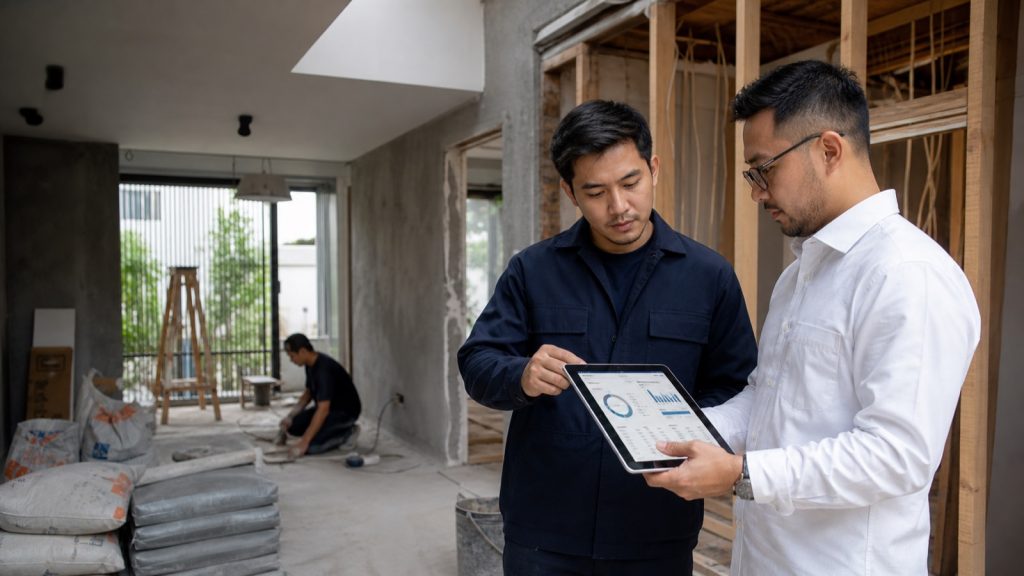
Renovation projects carry more uncertainty than new construction because some conditions become visible only after demolition. Effective cost control must begin before construction and continue through records of commitments, changes, progress, and forecast final cost.
1. Define the renovation scope and boundaries
Document the work areas, retained areas, required finish standards, temporary works, protection of the existing building, and responsibility for moving contents. Photograph the initial condition and record existing damage to prevent later disputes.
2. Survey existing conditions
Inspect the structure, walls, roof, plumbing, electrical systems, moisture, and access. If an area cannot yet be opened, treat it as a risk or provisional sum rather than a certainty. Connect survey findings to design and cost decisions.
3. Establish a baseline budget
Separate principal work, demolition, disposal, concealed repairs, protection, new materials, and indirect costs. Use measured quantities wherever possible and record allowances for items that have not yet been selected.
4. Prepare a risk allowance
Base contingency on identified risks, such as hidden structural damage, undocumented utility routes, unavailable legacy materials, or working-hour restrictions. Do not combine contingency with normal work costs because this makes monitoring difficult.
5. Control changes before work starts
Every change should state its description, reason, drawing or instruction, estimated cost, time effect, and approval. Where emergency work must proceed immediately, record evidence and define the work boundary on the same day.
6. Maintain a cost commitment log
Record contracts, purchase orders, material orders, and subcontracts. Separate the budget, committed amount, paid amount, and estimated balance. This keeps incurred but not yet invoiced expenditure visible.
7. Verify progress and payments
Do not assess payment from a general percentage alone. Check installed work, materials on site, quality, testing, and incomplete obligations. Avoid paying an item in full while defects or handover documents remain outstanding.
8. Update the forecast final cost
Each reporting period, calculate the estimated cost at completion: actual cost plus open commitments, anticipated changes, and remaining work. Compare it with the baseline to identify overruns early.
9. Record material decisions
Finish selections frequently cause cost changes. Maintain a decision schedule showing specifications, budget limits, required dates, approval status, and lead times. Late decisions can increase prices and disrupt the programme.
Routine cost-report checklist
- Original budget and approved revisions.
- Committed contracts and orders.
- Actual payments and uninvoiced liabilities.
- Approved, rejected, and pending variations.
- Contingency use and remaining risks.
- Forecast final cost and variance from baseline.
To structure initial renovation quantities and costs, use the BOQ & Labour Cost Calculator Pro. For workforce strategy, also read the Labour-Only Contract vs. Daily Labour Analysis.
Conclusion
Renovation cost control depends on disciplined documentation. Scope, concealed conditions, changes, commitments, and forecasts must be reviewed together. The earlier a variance is identified, the more options remain before the cost is incurred.
Professional implementation framework
Renovation cost control requires a baseline flexible enough for existing-condition uncertainty while remaining disciplined about change. Uncertainty does not justify accepting additions without evidence, instruction, quantity, price, and impact assessment.
Roles and accountability
The owner sets budget and authority; the project manager controls decisions; the quantity surveyor maintains cost plan, commitments, valuations, variations, forecast, and final account; designers manage design change; site teams record conditions; procurement manages contracts; finance reconciles payment.
Mandatory inputs and hold points
Scope and condition survey, design basis, estimate, budget, contingency, contracts, BOQ, procurement plan, baseline schedule, cash flow, commitment register, payments, variations, risks, forecast, and approval matrix are required. Separate owner contingency, design development, and construction risk.
Every hold point must be recorded in the Inspection and Test Plan. Work must not proceed on verbal approval alone when the next activity will conceal or remove inspection evidence.
Control sequence
- Define original budget, approved changes, current budget, commitments, actual paid, accrual, forecast to complete, and estimate at completion consistently.
- Record every contract and purchase order in the commitment register and reconcile invoice, valuation, retention, advance, and tax.
- Use early warning and change registers for concealed conditions, design, instructions, and owner choices, valuing them before execution where possible.
- Update cost reports periodically with variance, trend, risk exposure, contingency drawdown, cash flow, and required decisions.
- Forecast remaining work and risk rather than subtracting payments from budget, challenging optimistic package assumptions.
Acceptance criteria
Reporting bridges original budget to current forecast, records all commitments, reconciles payments, separates pending change, controls contingency approval, and assigns explanation and action to variance.
Convert each criterion into a checklist item supported by a measurement, compliant/noncompliant status, location, date, document revision, inspector, and photograph. Terms such as good or adequate are not acceptable without a defined measure or reference.
Quality records and handover
Retain budget approvals, estimates, commitments, contracts, purchase orders, valuations, invoices, payments, variations, risks, contingency approvals, cost reports, cash flow, forecast basis, decisions, and final account.
Index records by area and date so they remain traceable during changes, claims, defects, and owner reviews. Incomplete documents become outstanding items with an owner and target closure date.
Risk and nonconformance
Renovation risks include concealed conditions, scope creep, direct work without instruction, owner material changes, rework, and unrecorded small work. Use dated site evidence and authority limits understood by all parties.
Do not conceal a finding with subsequent work. Identify the area, review the cause, approve corrective action, and reinspect. A repair is closed only when objective evidence confirms that the required function and quality have been restored.
Work close-out
At completion, reconcile commitments, payments, retention, variations, claims, contingency, and outstanding work. The final cost report explains movement from original budget and provides a benchmark for future renovation.