
A useful progress report does more than present a percentage. It explains what was completed, what is delayed, why the variance occurred, its impact, required decisions, and the recovery plan.
Set a cut-off date and data sources
Use one reporting cut-off for physical progress, schedule, cost, materials, labour, and issues. Evidence should be traceable to site measurements, photographs, inspection records, daily reports, and approved documents.
Measure progress consistently
Define weighting by value, quantity, milestone, or another agreed method. Avoid subjective claims such as nearly complete. Use measurable milestones or zero-one-hundred rules where percentages are unreliable.
Compare planned and actual progress
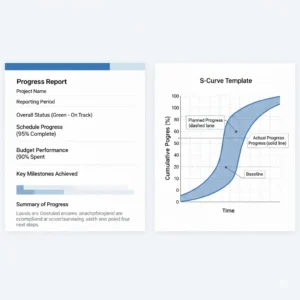
Show planned progress, actual progress, variance, trend, and forecast. Explain critical activities, procurement delays, design issues, and decisions required.
Integrate cost and change information
Report commitments, payments, variations, contingency, and forecast final cost. Strong physical progress does not guarantee cost health when pending changes remain unrecorded.
Use relevant visual evidence
Photographs should include date, location, description, and a link to the work item. Select images that prove progress or clarify a problem.
Close with an action register
Each issue needs an action, owner, due date, status, and escalation route. Start the next meeting by reviewing previous actions so the report drives management.
Professional report structure
- Executive summary and required decisions.
- Milestone dashboard and progress curve.
- Schedule and critical-path analysis.
- Cost, commitments, payments, variations, and forecast.
- Procurement, submittals, RFIs, and critical materials.
- Quality, tests, NCRs, safety, and environment.
- Risks, issues, actions, and evidence.
Data integrity and meeting governance
Use an approved weighting method and reconcile package totals to project progress. Distinguish off-site fabrication, materials on site, installed work, and accepted work where the contract treats them differently.
Issue the report before the meeting. Use meeting time for decisions and escalation, record owners and due dates, and issue controlled minutes and an action register afterward.
Supporting products
Use RAP Contractor Pro to monitor delivery costs and the Quantity Surveyor Pro Template Package to standardise reports and registers.
Conclusion
An effective report integrates site evidence, schedule, cost, change, risk, and actions. It should be concise but strong enough to support decisions before a variance becomes a major problem.
Professional implementation framework
A progress report compares plan, actual, forecast, cost, quality, safety, risk, procurement, and decisions at one common data date. Photographs and unsupported percentages are not sufficient for project control.
Roles and accountability
The project manager approves narrative and actions; the planner controls schedule and cut-off; the quantity surveyor validates quantities and value; site engineers confirm field status; procurement updates materials; QA/QC and safety provide quality and safety indicators; document control protects data sources and distribution.
Mandatory inputs and hold points
Use the baseline and schedule update, WBS, progress measurement procedure, quantity records, daily reports, labour and equipment logs, procurement register, RFI and submittal registers, cost report, variation log, risk register, quality and safety records, and dated photographs.
Every hold point must be recorded in the Inspection and Test Plan. Work must not proceed on verbal approval alone when the next activity will conceal or remove inspection evidence.
Control sequence
- Set the cut-off and data date, freezing source data so every report section covers the same period.
- Measure progress by approved 0/100 rules, weighted milestones, installed quantities, or another defined method rather than subjective judgment.
- Reconcile field progress, schedule, quantities, invoices, and cost reports, explaining differences before issue.
- Present planned, actual, variance, forecast, critical path, look-ahead, constraints, actions, owners, and dates.
- Complete management review, record decisions, distribute the final revision, and track actions to closure.
Acceptance criteria
The report uses a consistent period, figures trace to evidence, totals avoid double counting, forecasts explain constraint impacts, photographs show date and location, and each major issue has an owner and target.
Convert each criterion into a checklist item supported by a measurement, compliant/noncompliant status, location, date, document revision, inspector, and photograph. Terms such as good or adequate are not acceptable without a defined measure or reference.
Quality records and handover
Retain cut-off data, progress sheets, schedule update, curves, quantity evidence, cost reconciliation, supporting registers, photographs, review drafts, final report, distribution, and action tracker.
Index records by area and date so they remain traceable during changes, claims, defects, and owner reviews. Incomplete documents become outstanding items with an owner and target closure date.
Risk and nonconformance
Principal risks are progress inflation, late data, context-free photographs, hidden baseline changes, and optimistic narratives unsupported by forecasts. Reconcile and approve data before using it for payment or decisions.
Do not conceal a finding with subsequent work. Identify the area, review the cause, approve corrective action, and reinspect. A repair is closed only when objective evidence confirms that the required function and quality have been restored.
Work close-out
The next report shows the status of previous actions, forecast changes, and reasons for movement. At project close, summarize productivity, variance trends, and lessons for final account and future projects.