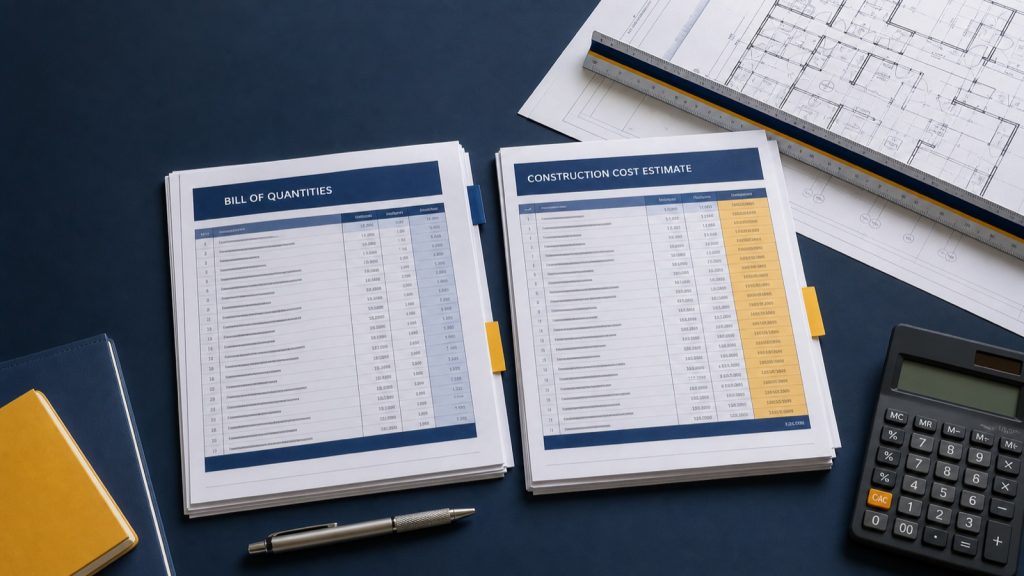
BOQs and construction cost estimates are both used in construction cost management, but they do not always serve the same purpose. Understanding the difference helps owners, consultants, and contractors select the correct document for procurement, tendering, and cost control.
What is a BOQ?
A Bill of Quantities (BOQ) is a systematically organised list of work based on drawings and specifications. It normally contains item descriptions, units, and quantities. During tendering, it provides a common measurement basis so all bidders price a comparable scope.
What is a construction cost estimate?
A construction cost estimate focuses on monetary value. It combines quantities with unit rates and adds relevant components such as preliminaries, overhead, profit, taxes, and contingency. It may be used as an owner’s budget, a consultant’s estimate, or a contractor’s bid, each with a different purpose and level of detail.
Comparison between a BOQ and a cost estimate
| Aspect | BOQ | Cost estimate |
|---|---|---|
| Main focus | Scope, descriptions, units, and quantities | Cost based on quantities and prices |
| Typical use | Tendering, measurement, and scope evaluation | Budgeting, bidding, and cost control |
| Prices | May be blank or completed by bidders | Normally includes unit rates and amounts |
| Main risk | Missing items or quantities | Unrealistic prices or cost assumptions |
Why are the terms often confused?
Many projects use the same spreadsheet format for both documents. Once unit rates are entered, a BOQ becomes a priced BOQ and may look similar to a cost estimate. The important distinction is not the file name, but its purpose, author, measurement rules, and contractual use.
When should a BOQ be used?
- When several contractors must bid for the same scope.
- When quantities must be traceable to the drawings.
- When progress payments use measured items and quantities.
- When variations must be valued consistently.
When should a cost estimate be used?
- When an owner needs to understand project funding requirements.
- When a contractor prepares a tender price.
- When the project team establishes a cost baseline.
- When actual expenditure is compared with the budget.
Recommended workflow
Start with controlled drawings and specifications. Prepare item descriptions, measurement rules, and quantities as a BOQ. Apply location- and period-appropriate unit rates to create a cost estimate or priced BOQ. Finally, review scope completeness, arithmetic, pricing assumptions, and risk.
Risks when the documents are not clearly distinguished
Ambiguity may cause bidders to make different assumptions, duplicate items, or leave important work unpriced. During construction, these issues can become claims, variations, or payment disputes. Every document should therefore have a clear title, revision, purpose, and scope notes.
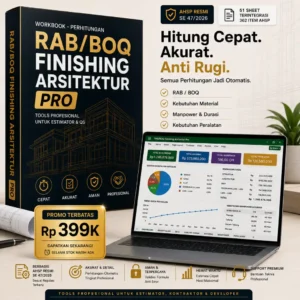
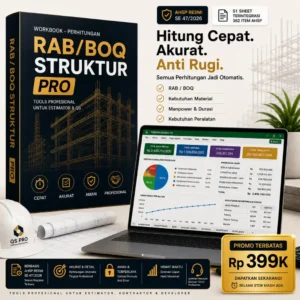
For measured structural and finishing formats, explore the Structural RAB/BOQ Calculation Workbook and the Finishing and Architectural BOQ Workbook Pro.
Conclusion
A BOQ explains what work is required and how much of it is measured; a cost estimate explains how much that work is expected to cost. They are closely related, but each needs a clear purpose, measurement basis, and set of assumptions.
Professional implementation framework
BOQ and cost estimate are related but serve different purposes. A BOQ primarily organizes scope and quantities for tender or contract, while an estimate predicts cost from quantities, prices, assumptions, and procurement strategy. Both require a common basis and coding structure for reconciliation.
Roles and accountability
The quantity surveyor defines measurement rules and document structure; estimators develop pricing; designers answer queries; procurement uses the BOQ for tender; contract administration applies contract documents to valuation; cost control compares budget, commitments, actuals, and forecast.
Mandatory inputs and hold points
Drawings, specifications, scope matrix, methods, measurement rules, WBS, take-off, rate database, quotations, preliminaries, allowances, risk, tax, and contract strategy are required. Design maturity determines certainty, so provisional quantities and allowances must be identified.
Every hold point must be recorded in the Inspection and Test Plan. Work must not proceed on verbal approval alone when the next activity will conceal or remove inspection evidence.
Control sequence
- Define whether the document supports an internal estimate, tender, contract, or cost control, as purpose determines detail and rules.
- Prepare preambles, measurement method, descriptions, units, quantities, and nonoverlapping work sections.
- Reconcile BOQ quantities to take-off and key parameters, checking specifications and temporary requirements for omissions.
- Develop the estimate through rates, preliminaries, overhead, tax, risk, and allowances without duplicating included components.
- After tender, bridge estimate, priced BOQ, clarifications, discounts, exclusions, and the recommended contract sum.
Acceptance criteria
Descriptions are sufficient for bidders, units and quantities are consistent, preambles state the rules, provisional items are visible, totals reconcile, and BOQ, estimate, and contract sum differences have a clear bridge.
Convert each criterion into a checklist item supported by a measurement, compliant/noncompliant status, location, date, document revision, inspector, and photograph. Terms such as good or adequate are not acceptable without a defined measure or reference.
Quality records and handover
Retain take-off, queries, unpriced and priced BOQs, estimates, rate build-ups, addenda, tender returns, clarifications, normalization, reconciliation, approval, and final contract documents.
Index records by area and date so they remain traceable during changes, claims, defects, and owner reviews. Incomplete documents become outstanding items with an owner and target closure date.
Risk and nonconformance
Common errors include treating the BOQ as the budget, comparing rates with different inclusions, missing specification items, treating provisional sums as fixed, and applying discounts twice. Use compliance and arithmetic checks.
Do not conceal a finding with subsequent work. Identify the area, review the cause, approve corrective action, and reinspect. A repair is closed only when objective evidence confirms that the required function and quality have been restored.
Work close-out
During delivery, keep the same coding for variations, valuations, commitments, forecasts, and final account. The BOQ then remains a bridge between technical scope and commercial control rather than a quantity table only.